MA & PhD opportunities: Beyond extractivism
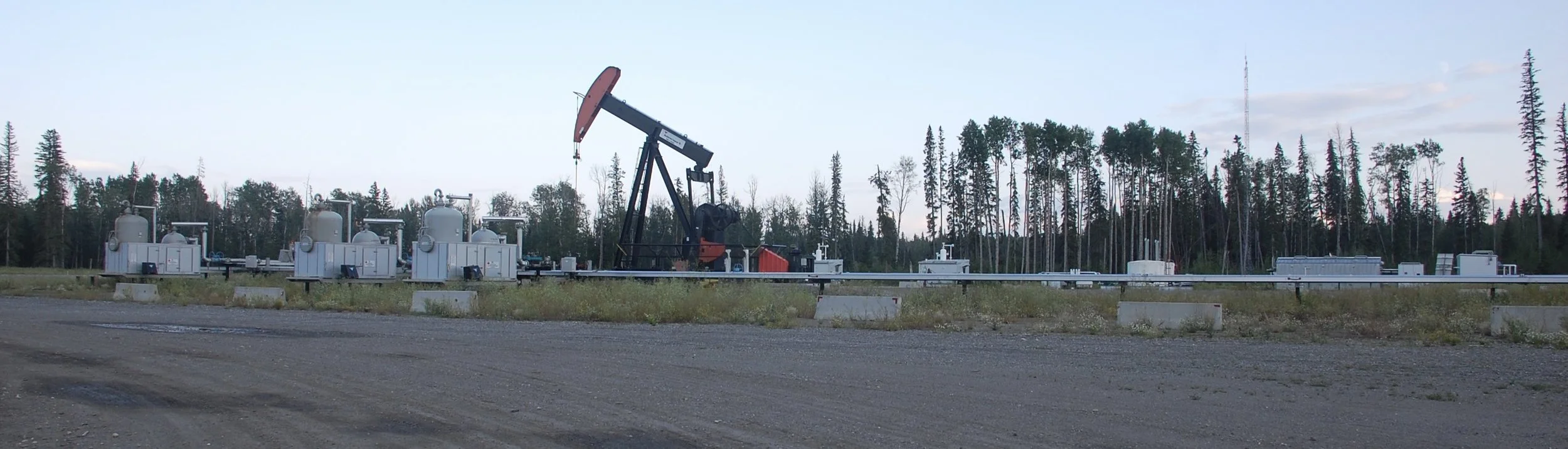
Oil pumpjack in Treaty 8 territory, northeast BC / author photograph
Ecosystems and economies face significant compounding challenges globally. Expanding resource extraction is responsible for 90 percent of biodiversity loss on land and often infringes on Indigenous rights. British Columbia is an epicentre of these challenges: over 1300 species are at risk of extinction in the province, driven largely by extractive land-use change; courts have ruled that cumulative impacts of extraction infringe on treaty rights. Governments justify this extraction as being in the national or public interest, but the economic benefits from extractive projects are at times overstated and, in some cases, declining. Our previous research found that mines approved in BC have underperformed across employment (-82 percent) and tax revenue (-100 percent). BC’s forest sector today employs 30 percent fewer people per unit harvest than in 2001, a loss of over 40,000 jobs. These patterns exemplify extractivism: a highly unequal distribution of benefits and costs from largely export-oriented extraction.
States all over the world, including BC, remain firmly on the resource extraction path despite these shrinking economic benefits and mounting costs, increasingly so in this moment of geopolitical upheaval and trade wars. Our project asks why alternatives to extractivism have remained out of reach, and what might make these changes possible in the years ahead?
We are at the beginning of a five-year Social Sciences and Humanities Research Council (SSHRC)-funded research project undertaking a close study of the political-economic barriers that have blocked and continue to block the BC government from advancing alternatives. We will be attentive to how interests (e.g., corporate power), structures, understood as norms, rules, regulations, institutions and governance arrangements (e.g., investment agreements), and common-sense ideas or narratives (e.g., fears of capital flight) shape state policy. The project will then investigate the fixity or flexibility of these barriers. For example, if legal challenges, capital flight or reduced investment emerges as key barriers, we will explore the extent to which that is a real or perceived barrier. And if they are real, what is the avenue for barrier removal?
We are looking for 2-3 MA or PhD students to join our research team at the University of British Columbia (UBC, Jess Dempsey), Simon Fraser University (SFU, Rosemary Collard) and the University of Victoria (UVic, Kara Shaw), starting in fall 2027. Each student will complete their degree in one home department: either geography at UBC or SFU or environmental studies at UVic, under our supervision. Each student will research and write a thesis on a topic they develop in relation to their own interests and barriers to moving beyond extractivism. We’re keen to work with students who have a wide range of backgrounds and skillsets, coupled with an inclination toward political economy/ecology.
The MA students will receive a minimum of $30,000 per year for two years and the PhD students a minimum of $35,000 per year for four years.
Each student must have:
A degree in geography, environmental studies or a related social science discipline
Strong analytical, writing and communication skills
Familiarity with and/or interest in political economy, alternative/heterodox economics, and/or critical social science (especially concerning resource extraction)
Experience with and/or interest in critical policy analysis, economics and/or accounting
The ability to work collaboratively and independently
If you’re interested, please send an email with the following materials copied to the three research leads (jessica.dempsey@geog.ubc.ca, rcollard@sfu.ca and shawk@uvic.ca) by Nov 1, 2026:
CV/resume and unofficial transcripts
A short (less than a page) expression of interest focused on why you’re interested in the project and what you hope to contribute. Please indicate whether you’re interested in applying to UBC geography, SFU geography, UVic environmental studies, or a combination/any of the above.
A writing sample (e.g. a term paper or published essay)